Photographing moving water has been a theme for me this year and I’ve really been enjoying experimenting with neutral density filters to slow down the shutter speed and blur the flowing water. It’s also been a good excuse to get out and visit new locations.

This weekend I followed up a suggestion by George Bowron and checked out the Oyster River “bowls.” The Oyster River cuts through what looks like sandstone at this location and the water has sculpted the rock into a series of bowls of all different sizes. The landscape is stunning and surreal.
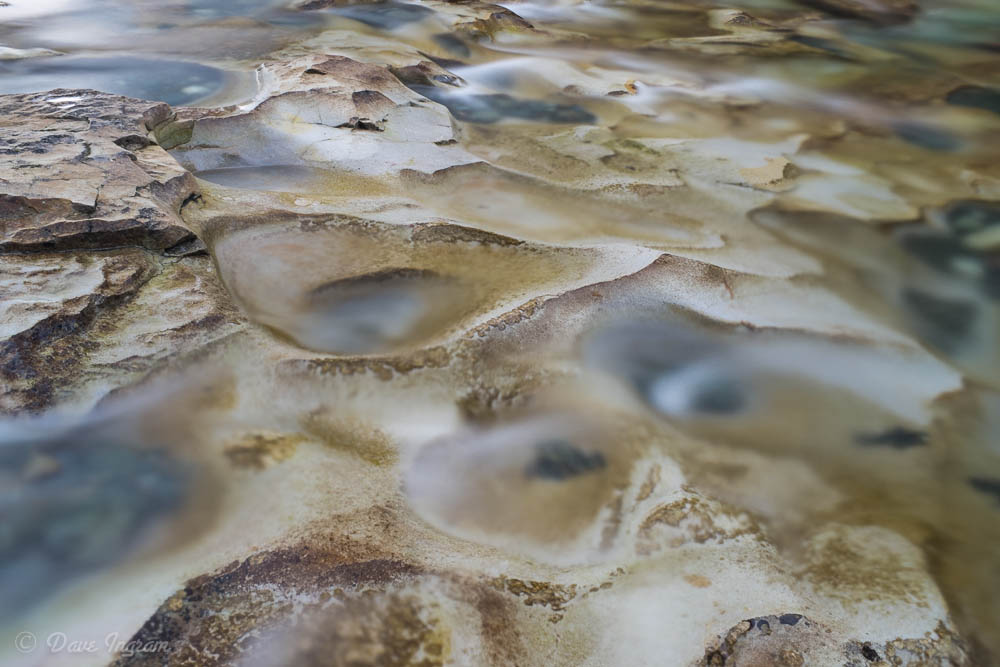
Since my Nikon D600 is being serviced for a second time with Nikon Canada (more dust and oil spots appeared despite a shutter replacement back in April —don’t be tempted by the current low price of this model, it’s not worth the hassle) I had the opportunity to try out my Fuji X100S. It definitely limited what I would normally do in terms of composition in comparison to using my 16-35mm lens and B+W filters.

In this case, I was forced to think with a 35mm equivalent field of view rather than going super wide and use a fairly “thin” ND filter (a Hoya ND8 – equivalent to about 2.5 stops) rather than the 6 or 10 stops that my B+W filters provide. I started looking for smaller scenes and more abstract combinations of water, stone, and rounded bowls.

The Fuji X100S performed extremely well. I couldn’t figure out how to access the longer shutter speeds so ended up using the Bulb mode. Holding the shutter down manually for 10 to 15 seconds with the camera on a tripod didn’t produce any noticeable camera shake and the image quality of the X-trans sensor was excellent.
At the end of the afternoon I was really happy with what I had captured. Sometimes photographing a small part of a place reveals more than the larger landscape!
More photographs of the Oyster River bowls can be viewed and prints ordered via my SmugMug site at Dave Ingram Photography: Oyster River Bowls.


Dave: This might interest you (or at least those w/o a powerful ND filter!) Photographing Moving Water – http://www.wolfnowl.com/2010/12/photographing-moving-water/
Mike.
Interesting read Mike – I’m thinking of trying something similar to stack a long exposure that blurs the water with a faster exposure that freezes moving plants that are often blurred during longer exposures.
Dave: Although you couldn’t do it in Lightroom, you could stack multiple images to create the moving water effect, then layer that with a single image for what you want to be non-moving and use a layer mask to edit out the moving plants, etc. Might be tricky depending on the scene, but certainly possible
I am new to the Courtenay area and wanted to hike to the Oyster River Bowls. Can you help me with directions??
Thankyou
Beth
Hi Beth,
It’s an easy walk down to the river – check this post with detailed directions: https://islandnature.ca/2013/12/sandstone-and-water/