
Earlier this week I discovered a community of mosses living on an old cement curb. I revisited them with the lofty idea of taking a sample or three back to the house and identifying them.
After all, how hard could it be to identify a moss?

Mosses are Tough to Identify
Armed with the RBCM handbook Some Common Mosses of British Columbia (WB Schofield) and my own naivety I quickly discovered I was in way over my head. It was fortunate that we have two both a dissecting and compound microscope at home as both are very useful when attempting to identify mosses. It was unfortunate that these didn’t help me to figure out what the mosses actually were.

After close to an hour looking at the first moss under the microscope, my wife Jocie, asked me why I had chosen such difficult mosses to identify. She should know, since she’s taken courses specifically on mosses at UBC. She also has a collection of mosses and liverworts that fills 17 shoe boxes on a top shelf in our guest room closet.

Some Moss Features
Working on the second moss that I had collected, I again examined it under the microscope and tried to pick out features that would help me identify it. What I learned was that things that I thought were distinctive didn’t really help me too much. I made little progress.
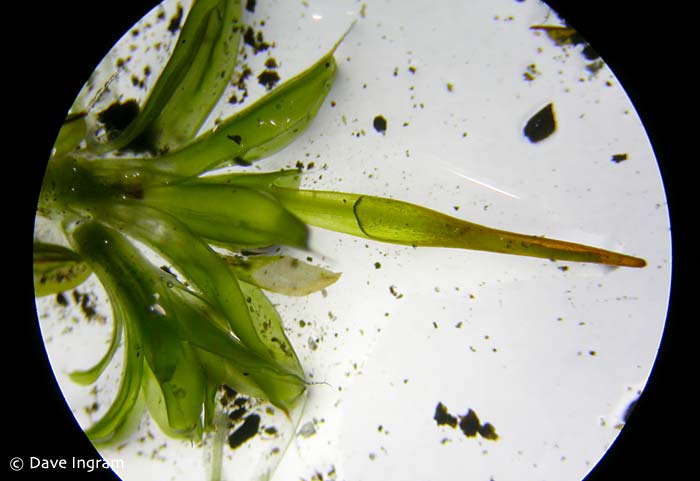
However, despite the fact that I was no closer to identifying this second moss I was still enjoying myself. The leaves were pretty neat to look at under the microscope and occasionally I would notice very small insects scurrying out of the moss itself. They didn’t really have anywhere to go since they were in a petri dish but hopefully they’ll survive until I return the moss to the curb.

The third moss in my collection mystified me as well. I think that at this point in the evening I had given up trying to pin a name on the moss. I began to admire it for being so common while at the same time being so complex as to defy my pathetic attempt to identify it. Some things are better appreciated for their simple beauty.
Jocie’s advice was to stick with the bigger and more easy to identify mosses when starting out and I think that’s what I’ll do!


Great photos! I have no idea what the mosses are either, but your photos bring out their beauty for sure.
Sorry I cannot help in your identification but I enjoyed looking at them. For the close ups are they on a light table? Loved these macros!
Thanks Amanda – I photographed the close-ups by hand holding a Nikon 4500 directly on the eyepiece of a dissecting microscope. It’s a little tricky to get the focus right but using the Nikon’s macro mode seems to produce a fairly good result most of the time. It is finicky and I really should look into getting a microscope adapter setup for the camera. The 4500 is a pretty good fit for taking photographs through a microscope since the lens and the eyepiece are about the same diameter.
Thanks Villager – I enjoyed these mosses even though I had no idea what they were!
You may not have identified the mosses, but you made a fine series of photos and a nice narrative.
Thanks John – I’m going to stick with the bigger, more easy to identify mosses for now (things like Step Moss and Electrified Cat’s Tail Moss that are larger and fairly distinctive).
What a fascinating post! I would be just like you, desperate to find out what I had, but floundering horribly in a unknown world!
I love the photos, especially those taken through the microscope. Excellent work!
Wow neat photos, specially the ones that you took through your microscope!
Good luck identifying those moss! On an artistic point of view, the first one is very nice 😉
I know so little about mosses! Fun to see you taking a close peak. I think they are all so amazing and beautiful.