Contrary to popular belief, it does snow occasionally at sea level on Vancouver Island. Every year in either late November or early December we get a snow fall that generally shuts down the schools and makes driving hazardous. This year the snow came in mid-December and was thick and heavy. It didn’t last long but it did do some damage to our yard shrubs. One casualty was our old lilac – the weight of the snow was too much for the main branch of the tree.
Yesterday I finally got around to cleaning up the debris. I also took the opportunity to look a little closer at the lichens that were growing on the lilac since they were now down at ground level. The variety of shapes, sizes and colours was fascinating.
I’ve attempted to work out the identification of these lichens and think that I’ve got them correct but without chemical testing and a microscope I’m relying on Pojar & MacKinnon’s Plants of Coastal BC and Lichens of North America by Brodo, Sharnoff and Sharnoff. If you’re looking for a great Christmas gift and have a few extra dollars to spend the latter is definitely worth giving to the lichen lover in your life.
Here are some of the lichens that I discovered:
Lichen Diversity
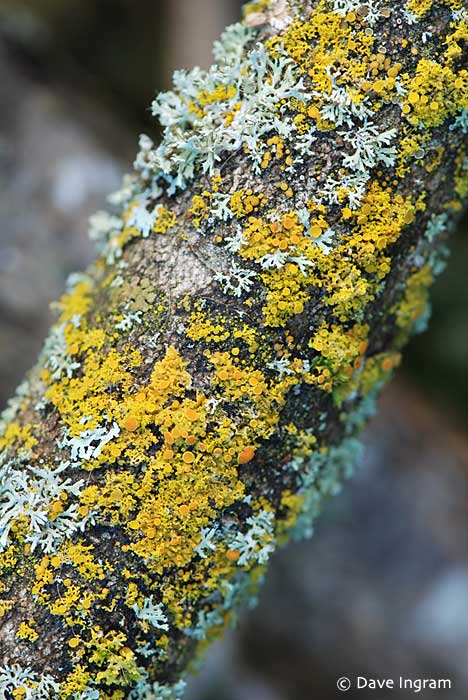
This first image shows the diversity of lichen shapes, forms and colours growing on one small section of a branch on the tree. It really made me appreciate how observing nature more closely often reveals more and more detail.

Pin-cushion Sunburst Lichen
The image below is Pin-cushion Sunburst Lichen (Xanthoria polycarpa), a small leaf lichen that forms loose pincushions up to 2.5 cm across. The numerous orange discs are the fruiting bodies or apothecia. In places, lichen covered the branches of the lilac. It often grows in association with bird droppings since it requires large amounts of calcium and nitrogen.
Waxpaper Lichen
This next photograph is Waxpaper Lichen (Parmelia sulcata). It is usually a blue gray colour and is often brown at the edges. The lobes of this lichen are 3 – 5 mm wide and have a network of ridges with soredia (whitish powdery balls). The lower surface of this lichen is black in colour.
Waxpaper lichen contains salzinic acid and has been used to make a yellowish brown to dark brown dye. Hummingbirds often use this lichen as nest material which helps to camouflage their nests.

Dotted Ramalina
I think that this last lichen is Dotted Ramalina (Ramalina farinacea) which is extremely variable morphologically. The thallus colour ranges from pale to dark yellowish green and the lichen itself can be pendent (hanging) to bushy in appearance. Apothecia on this species is rare.

After spending some time appreciating the beauty of the lichen on these fallen branches I can only hope that new lichen will begin to colonize the new growth on what remains of our lilac. Right now it looks a little bare.

If you’ve enjoyed this post, consider reading Pixie Cups on the Fence, a lovely introduction to Cladonia over at Wanderin’ Weeta.


I “like” the post title. The only thing I know about lichen is that it only grows where the air quality is good. Great photos.
I love the title! LOL!
These photos are amazing – the waxpaper lichen is particularly beautiful – I’m pretty sure we don’t have that one here, but like Sara, I know that leafy lichens only grown in areas where the air quality is good and an awful lot of the UK is pretty polluted with traffic fumes if nothing else. We see a lot of hard lichens, but few leafy.
” … If you’re looking for a great Christmas gift and have a few extra dollars to spend the latter is definitely worth giving to the lichen lover in your life.”
Hahaha! Yes, I’ll remember that, but first I’ll have to think of a lichen-lover who lives in North America! I’d like it though – or at least, an equivalent British lichens book – to go with my flora, fauna and invertebrates reference books!
Great post! Very helpful to me as well since I was taking pictures of bark on the weekend and one of my captures is a lichen-covered pine tree. Thanks 🙂
Hi Jay, thanks for the comment. I imagine with the number of naturalists in England that there must be a good lichen book in print somewhere!
Great pictures, Dave, and helpful info too. I took a picture of P. sulcata a few days ago. Now I know what it is.
Merry Christmas,
Hugh
Hi Hugh – thanks. I’m 95% sure on the ID of these lichens but without chemical testing and a microscope … or asking Terry Taylor for some assistance.
P. sulcata is described in Lichens of NA as being an “extremely widespread, even weedy species in the north and west” and is one of the first lichens to appear on trees and benches in cities. I found more of it growing on Common Hawthorn at Buttertubs Marsh.
Wow, Dave– great photos and an excellent story. Thanks for taking a close look. Like you, I think you’ve got the IDs down on the Xanthoria and P. sulcata, but can’t vouch for the others. You might check out Hypogymnia for the grayish one that dominates the first photo if you haven’t already.
Thanks for bringing attention to these wonderful critters…
Hi Sally, Thanks for visiting and for the feedback. I think you’re right about the first image, I’m just going to leave it at Hypogymnia sp. for now though!
For those in the UK the brand new edition of the standard reference book just came out:
The Lichens of Great Britain and Ireland (2009). Edited by C.W. Smith, A. Aptroot, B. J. Coppins, A. Fletcher, O. L. Gilbert, P.W. James and P. A. Wolseley. It is published by the British Lichen Society. http://www.thebls.org.uk
Hi Dennis – thanks for this, I know a couple of my British readers were looking for a lichen book for the British Isles!